
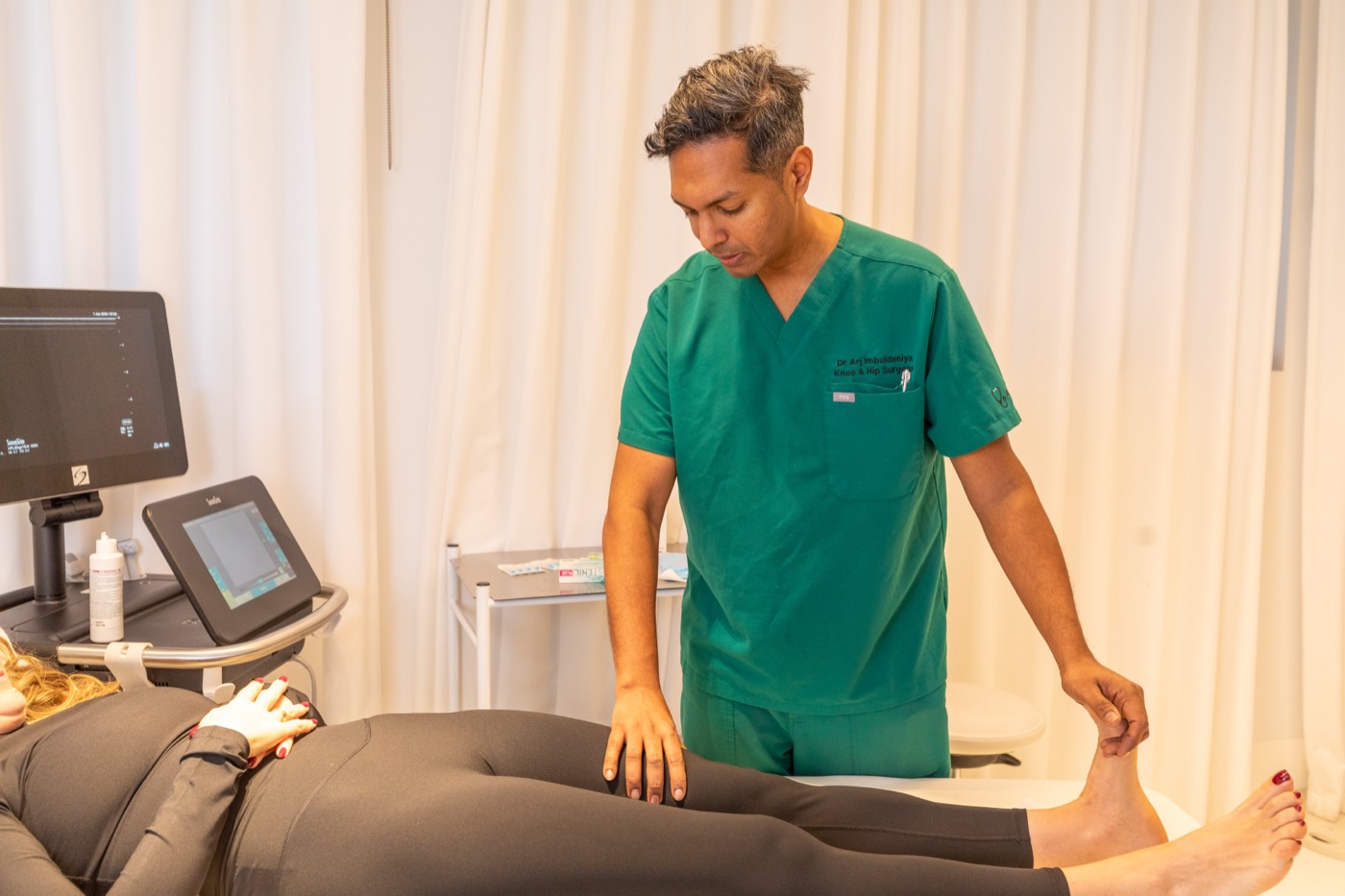
“Do I need knee surgery?” is one of the most common questions I'm asked, and one of the hardest to answer responsibly from the outside. The honest reply is almost never a flat yes or no — it's a set of questions most people are never actually asked.
I'm Dr Arj Imbuldeniya, a Consultant Orthopaedic Knee & Hip Surgeon. I operate every week and I replace and repair knees that genuinely need it. So when I tell a patient their knee may not need surgery yet, it isn't because I'm against operating. And when I tell another that it does, it isn't because I reach for surgery lightly. The aim is the same in both cases: the right decision, at the right time, for that particular knee.
Why a scan can't answer the question on its own
Most people expect the X-ray or MRI to settle it. It can't — and understanding why is the single most useful thing in this whole article.
A scan is very good at showing structure: the state of the cartilage, the bone, a meniscus. What it cannot show is how strong the muscle around the joint is, how your metabolism is driving inflammation inside the knee, how well you recover from load, or what your genetic risk looks like. Those factors hugely affect how a knee feels and functions — and none of them appear on the image.
This is why the same worn-looking X-ray means very different things in different legs. In a strong, well-recovered, metabolically healthy leg, that knee may have years of good function left. In a deconditioned one, it won't. We treat the person, not the picture — and a striking number of knees labelled “bone on bone, time for surgery” have simply never had the biology around them properly addressed.
Knee care fails in two opposite directions
Here is the part the usual “to operate or not” debate misses entirely. Knee care doesn't fail in one direction — it fails in two.
On one side, knees are operated on too soon, before anyone has seriously addressed the muscle, the metabolic health or the mechanics around the joint. On the other, knees that genuinely need an operation are quietly steered away from one, sometimes for years, while the leg weakens and the problem hardens. Both are failures. Both happen every week.
That's why “do I need surgery?” can't be answered by a reflex in either direction. The easy positions — always operate, never operate — are both wrong. The honest one is harder, and it depends on your knee, not a slogan.
The three questions that actually decide it
When I'm weighing whether a knee needs surgery, I'm really asking three things:
- How much is it affecting your life? — not how dramatic the scan looks, but what the knee is actually stopping you doing, and how much pain it's driving day to day.
- How much modifiable biology is left? — is there muscle to rebuild, metabolic health to improve, movement to restore? If those levers have never been pulled, there may be real room before an operation.
- Can the structure realistically be restored any other way? — where the joint surface or a key structure is genuinely beyond saving, no amount of well-sequenced biology will rebuild what's gone, and surgery moves up the list.
It's the combination that decides it, not any single answer. A knee scoring badly on a scan but with plenty of modifiable biology, and only modest impact on life, is in a very different place from a knee where the structure is beyond restoring and the pain dominates everything.
What's worth trying first — and why it isn't “doing nothing”
When surgery isn't yet necessary, the alternative is not “wait and hope.” It's a structured sequence: resetting the metabolic and inflammatory groundwork, restoring the quality of how the knee moves, and above all building the muscle that protects, controls and offloads the joint — the single highest-evidence, most underused tool we have. Targeted orthobiologic treatment has a place too, but further down the sequence than most expect, and only into a joint that's been properly prepared.
I founded OrthoLongevity on one principle — biology-first, surgery-last. Surgery-last has never meant surgery-never; it means we arrive at an operation, when one is genuinely needed, with the muscles as strong as possible and the biology as good as we can make it, so the result is better. In my own practice over the last two years, 8 in 10 of the patients I saw did not go on to surgery, not because an operation was withheld, but because the biology was addressed in time. I've set out that pathway in full in Alternatives to Knee Replacement.
When surgery genuinely is the right answer
And then there are the knees that need operating on — where the structure is beyond restoring, the pain is dominating a life, and no amount of biology will rebuild what's gone. For those knees, a well-timed, well-planned operation is one of the most reliably transformative things in medicine, and delaying it out of a blanket fear of surgery does real harm: more pain, more lost muscle, a harder recovery.
The right operation is matched to the individual knee — from joint-preserving procedures such as an osteotomy or cartilage and meniscus work, through to partial or total knee replacement when that's genuinely what's needed. I see myself as a selective surgeon, not a reluctant one — the surgeon you want, whether you need surgery or not. The job isn't to avoid theatre at all costs; it's to make sure that if you get there, it's the right call, made at the right time.
Whether you need knee surgery is a clinical decision, not something to settle from an image. Every OrthoLongevity assessment begins in person at Lanserhof at The Arts Club in Mayfair, where structure, strength, metabolic health, movement and genetic risk are weighed together by someone accountable for the whole picture. If an operation is genuinely the answer, it's planned and carried out properly — but only once the case for it is clear.
Before you decide, know where your knee actually stands
Before any of this — a second opinion, injections, a date in the diary — the most useful first step is an honest sense of how your knee is really doing and how much modifiable biology you have to work with. That's exactly what the free Knee Age test is for: a 60-second, surgeon-designed self-assessment that estimates the biological age of your knee and points to the drivers that matter most for you. The thinking behind it is explained in What Is Your Knee Age?
If you take one thing from this article, let it be this: “you need knee surgery” is the start of a conversation, not the end of one. Find out where you actually stand before you accept it as settled.