Patients arrive in my clinic all the time having been told, somewhere along the way, that they need a knee replacement. A good number of them don't — at least not yet, and not before some honest work has been done first.
I'm Dr Arj Imbuldeniya, a Consultant Orthopaedic Knee & Hip Surgeon. I operate every week, and I replace knees that genuinely need replacing. So when I say there are real alternatives worth exhausting first, it isn't because I'm against surgery. It's because I've seen what happens when we reach for it too early — and, just as importantly, what happens when we leave it too late.
Knee care fails in two opposite directions
This is the part the usual “surgery versus no surgery” debate misses entirely.
On one side, knees are operated on too soon — replaced before anyone has seriously addressed the muscle, the metabolic health or the mechanics around the joint. On the other side, knees that genuinely need an operation are quietly steered away from one, sometimes for years, while the leg weakens and the problem hardens. Both are failures. Both happen every week.
I think this argument is only credible coming from someone who operates a great deal — because the easy positions are to be reflexively pro-surgery or reflexively anti-surgery, and both are wrong. The honest position is harder: the right intervention, at the right time, for that particular knee. That is what an alternative to knee replacement actually means. Not avoidance at all costs — the right call.
Why so many knees are more salvageable than they look
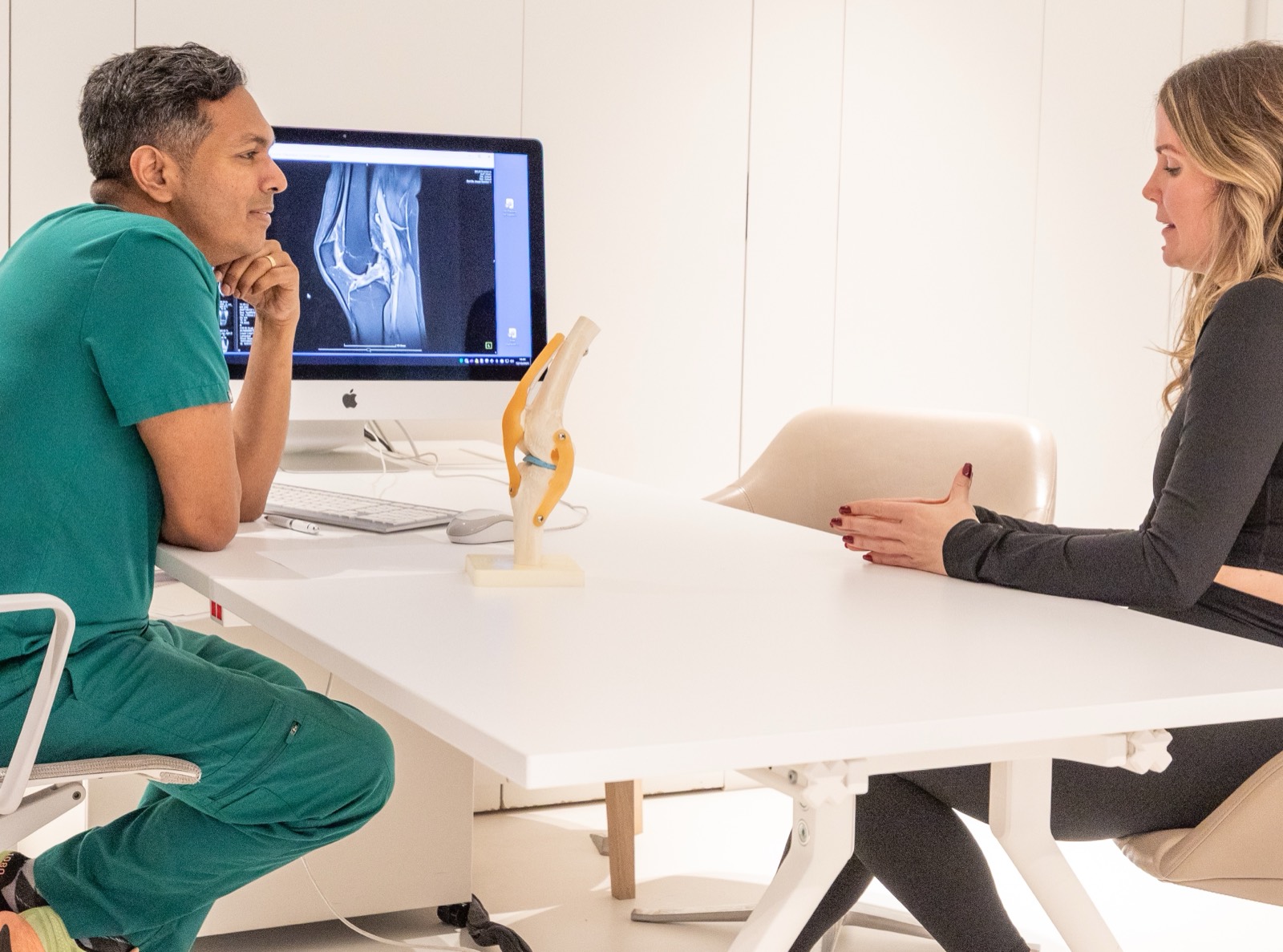
An X-ray or MRI is very good at one thing: showing structure. The state of the cartilage, the bone, a meniscus. What it cannot show is how strong the surrounding muscle is, how your metabolism is driving inflammation inside the joint, how well you recover from load, or what your genetic risk looks like. Those factors enormously affect how a knee feels and functions — and none of them appear on a scan.
This matters because the same worn-looking X-ray means very different things in different legs. In a strong, well-recovered, metabolically healthy leg, that knee may have years of good function left in it. In a deconditioned one, it won't. We treat the person, not the picture — and a striking number of knees labelled “bone on bone, time for a replacement” have simply never had the biology around them properly addressed.
I founded OrthoLongevity on a single principle: biology-first, surgery-last. Surgery-last has never meant surgery-never — it means we reach an operation, when one is genuinely needed, with the muscles as strong as possible and the biology as good as we can get it, so the result is better. In my own practice over the last two years, 8 in 10 of the patients I saw did not go on to surgery, not because an operation was withheld, but because the biology was addressed in time.
What actually changes a knee before replacement
When a replacement isn't yet necessary, the alternative isn't “do nothing and hope.” It's a structured sequence. We don't stack treatments at random — we sequence adaptation, in roughly this order:
- Reset biology — optimise metabolism, inflammatory load, sleep, stress and nutrition. Very little downstream works as well without this foundation.
- Enhance movement — restore the quality of how the joint actually moves (range, control, gait, biomechanics) before asking more of it.
- Power — build the muscular infrastructure that protects the joint for life. Strength training is the single highest-evidence modifiable intervention for joint longevity, and the most underused.
- Augment healing — targeted orthobiologic treatment, at the right moment, into a joint that has first been biologically prepared. Sequence matters more than the injection itself.
- Intervene surgically — precisely targeted surgery when structure genuinely can't be restored any other way.
- Resilience — long-term monitoring, annual reassessment and sustainable self-management, so a good result lasts.
This is gate-governed, deliberately. No injection is offered as a first move, and no surgery is recommended until the case for it is genuinely made. The point is to give a knee every fair chance before anyone reaches for a replacement — and to know, honestly, when those chances have run out.
The non-surgical options, honestly
People usually want to jump straight to the injection conversation — does PRP work, what about Arthrosamid, what about a gel injection? They have a place, but they belong further down the sequence than most expect, and they are not a like-for-like replacement for a replacement.
Strength and conditioning is, unglamorously, the most powerful non-surgical tool we have. The muscle around a knee protects it, controls it and offloads it; rebuilding that capacity changes how a joint feels and performs more reliably than almost anything else. Metabolic health — weight, inflammation, blood-sugar control — sits underneath all of it, because your joints live inside your overall biology, not apart from it.
Orthobiologic and injectable treatments — including high-dose PRP, Arthrosamid and hyaluronic acid — can help selected knees once the groundwork is in place. But the evidence and the benefit vary considerably from joint to joint, and these are clinical judgements made after assessment, not choices to make from an article. I won't prescribe a specific protocol in a blog, and you should be wary of anyone who does.
Where the problem really is structural, there are still joint-preserving surgical alternatives short of a full replacement. A well-chosen osteotomy can realign a knee and shift load off a worn compartment; cartilage and meniscus procedures can restore function in the right candidate. For some people these delay a replacement by many years — or remove the need altogether.
When a knee replacement genuinely is the right answer
And then there are the knees that need replacing — where the structure is beyond restoring, the pain is dominating a life, and no amount of well-sequenced biology will rebuild what's gone. For those knees, a modern replacement is one of the most reliably transformative operations in medicine, and delaying it out of a blanket fear of surgery does real harm: more pain, more lost muscle, a harder recovery.
I see myself as a selective surgeon, not a reluctant one — the surgeon you want, whether you need surgery or not. The job isn't to avoid the operating theatre. It's to make sure that when you get there, it's the right decision, made at the right time, for the right knee — and that everything sensible was tried first.
Working out whether you can avoid a replacement is a clinical decision, not something to settle from an image or a quiz. Every OrthoLongevity assessment begins in person at Lanserhof at The Arts Club in Mayfair, where the structure, strength, metabolic health, movement and genetic risk are weighed together by someone accountable for the whole picture. If surgery is genuinely the answer, it's planned and carried out properly — but only once the case for it is clear.
Start by knowing where your knee actually stands
Before any of this — injections, surgery, second opinions — the most useful first step is an honest sense of how your knee is really doing and how much modifiable biology you have to work with. That's exactly what the free Knee Age test is for: a 60-second, surgeon-designed self-assessment that estimates the biological age of your knee and points to the drivers that matter most for you. It's the same logic this whole approach runs on — explained in more depth in What Is Your Knee Age?
If you take one thing from this article, let it be this: “you need a knee replacement” is the beginning of a conversation, not the end of one. Find out where you actually stand before you accept it as settled.